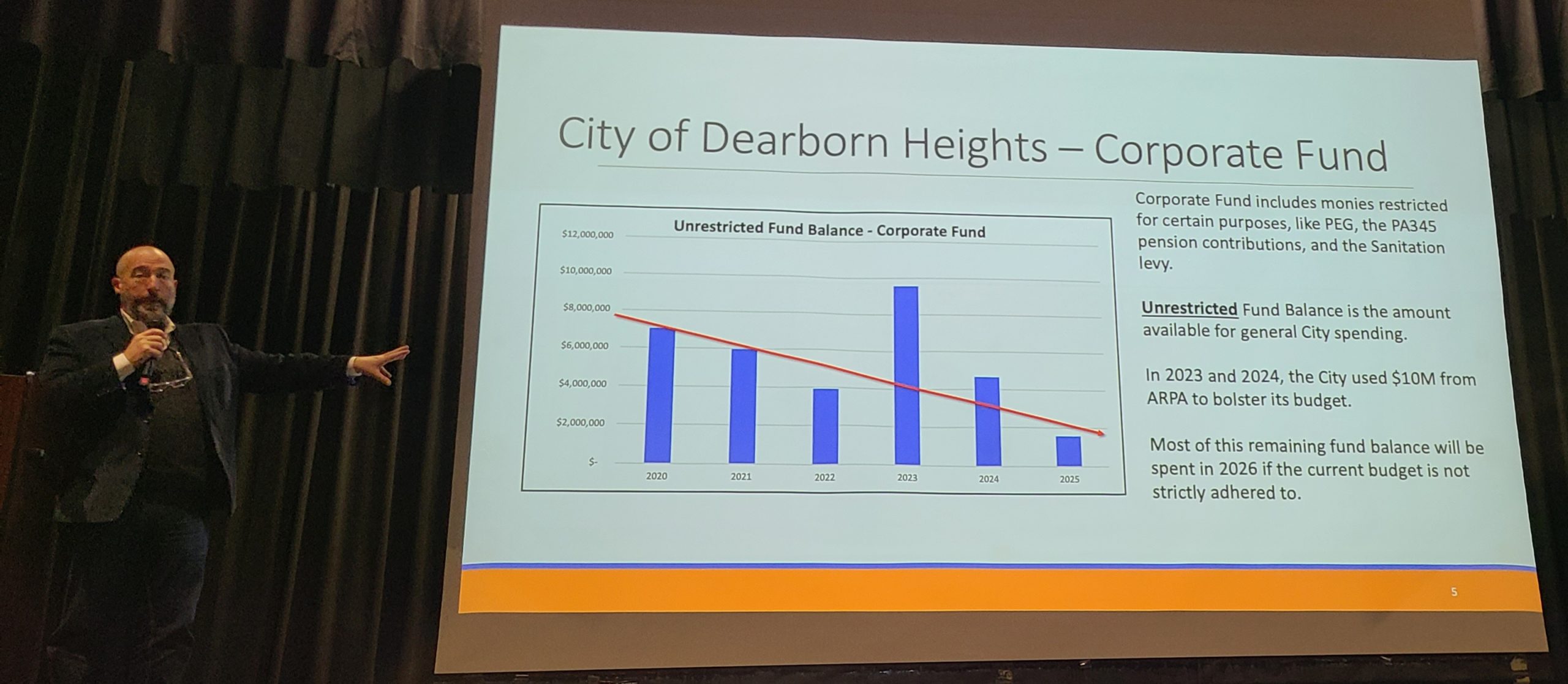
Brian Camiller of Plante Moran speaks Dec. 10 at a Dearborn Heights town hall meeting at Annapolis High School about the city’s fragile financial position and how it is trending in the wrong direction and spending more than it is bringing in, with American Rescue Plan Act money bolstering its budget by $10 million in 2023 and 2024.
City is spending more money than it is bringing in
By SUE SUCHYTA
Times-Herald Newspapers
HEIGHTS – Plante Moran’s Brian Camiller told residents during a town hall meeting Dec. 10 at Annapolis High School that the city’s financial position is fragile and trending in the wrong direction.
He said the city is spending more than it is bringing in, and used $10 million in American Rescue Plan Act money in 2023 and 2024 to bolster the city budget.
Camiller said that most of the city’s remaining fund balance is from the city’s water and sewer fund.
He said the city also has an obligation to fund its general governmental pension, which maintains public safety pensions as well as retiree health care.
Camiller said that the city’s financial position has been deteriorating as key indicators trend downward.
“Dearborn Heights faces significant financial challenges,” he said. “Some balances and metrics may appear acceptable at first glance. However, when the numbers are examined in context, they reveal an alarming story that warrants urgent attention.”
In good news, Camiller said the city has $11 million to spend on major street projects, and the mayor is working on obtaining additional revenue sources.
He said the city’s 2023 budget included an $8 million ARPA grant infusion, which makes the city’s corporate or general fund appear stable, but is actually an illusion.
Camiller said corporate fund money is restricted to specific purposes, such as pension allocations and the sanitation levy.
He said the unrestricted fund balance is what the city uses for its general spending, and since it spent $10 million in ARPA money in 2023 and 2024, most of the remaining unrestricted fund balance will be spent in 2026 if the city does not strictly adhere to its current budget.
Camiller said it looks like the water and sewer fund is accumulating cash and is in a strong position for the end of the 2025 fiscal year, but that is also an illusion.
He said the city has a substantial list of capital projects in the fiscal year 2026 budget that will be paid for through a combination of bond projects, remaining ARPA funds and the city’s cash reserves. Once the projects are completed, the city’s cash reserves will be more modest.
Camiller said the city’s General Government Pension system is 73 percent funded, which is 10 percent more than required by Michigan Employees Retirement System, which is good, but maintaining the fund at that level puts a strain on the city budget.
He said the city’s police and fire pension system and retiree health care has its own source of funding, which does not directly influence the city budget. However, maintaining the fund is costly, as the operating millages have decreased over time while retiree health care costs have risen.
Camiller said that for every dollar of property taxes spent for operations, 44 cents goes to police and fire legacy costs.
He said combined pension contribution for both systems has increased 176 percent over the past 10 years.
Camiller said for every dollar of wages paid to police and fire, 45 cents goes to legacy costs, while for other city employees, the legacy cost is 28 cents. He said both of these are higher than average and not sustainable in the long term if the city wants to maintain its service levels without a significant increase to tax revenue.
He said the city’s financial position has been deteriorating, with key indicators trending downward, and significant capital needs and operating shortfalls threaten the city’s ability to maintain essential services.
Camiller said immediate and sustained action is required, including new revenue sources, cost containment strategies and outside-the-box thinking and bold tactics.