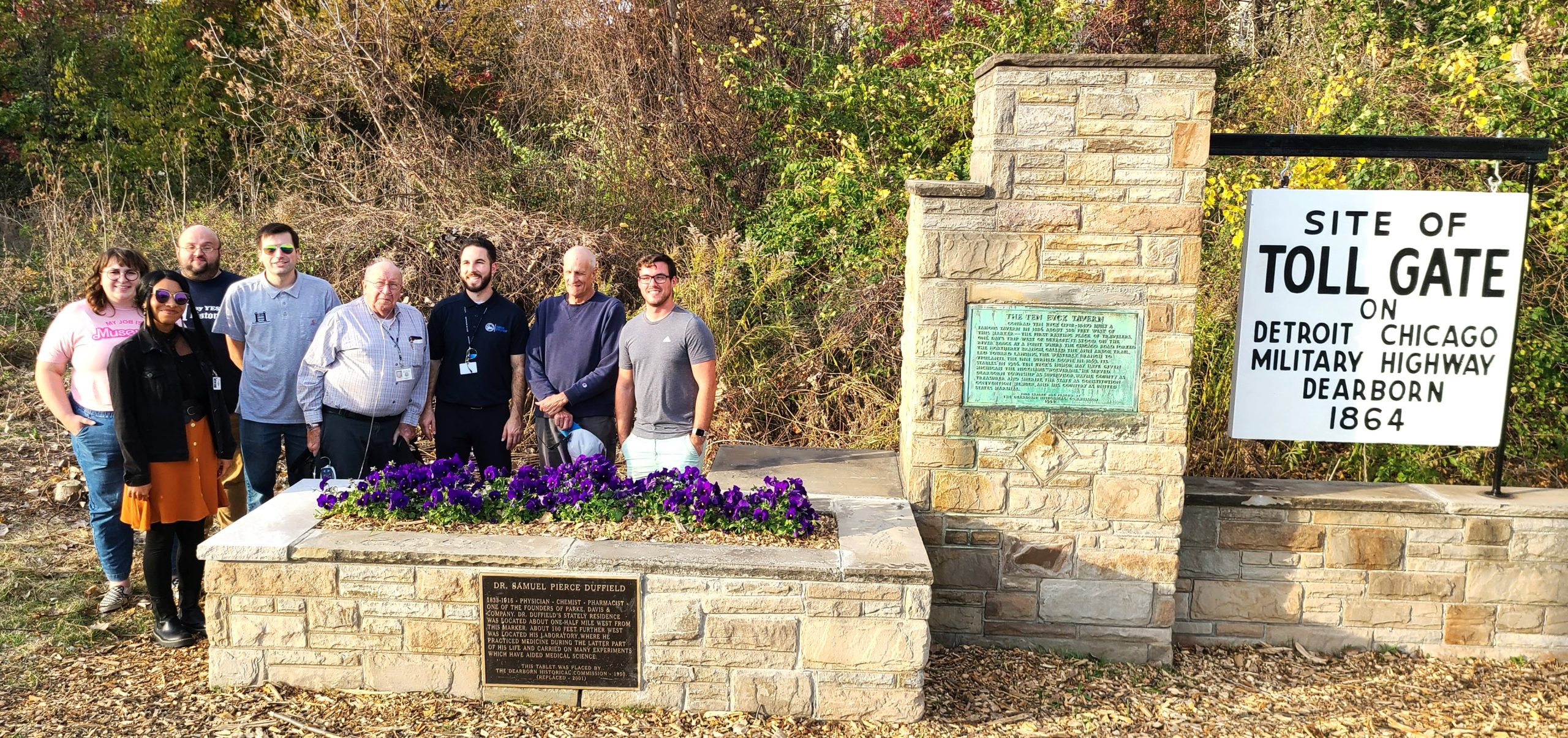
The refurbishing of the Dearborn Toll Gate Historical Marker, on westbound Michigan Avenue, east of Evergreen Road, is celebrated Oct. 29 by Dearborn Historical Museum Collections Manager Karely Byrd-Nowsch (left), Archivist Amanda Ford, Archivist Mason Christensen, Assistant Curator Matt Graff, Director and Chief Curator Jack Tate, Dearborn Mayor Abdullah Hammoud, museum volunteer Tom Saroglia, and Building and Exhibits Manager Tyler Moll.
By SUE SUCHYTA
Times-Herald Newspapers
DEARBORN – The restoration of the Dearborn Toll Gate historical marker on westbound Michigan Avenue east of Evergreen Road was recognized Oct. 29 by Historical Museum supporters and Mayor Abdullah Hammoud.
The Dearborn Historical Museum Building and Exhibits Manager Tyler Moll and volunteer Tom Saroglia spearheaded the project.
Moll said the cleanup of the monument has been on the museum’s to-do list for some time, so two summers ago they started with a clean-up of the grounds around the marker.
“There were weeds, and there were vines all over it,” he said. “The sign was kind of hanging off by one little hook.”
Moll said this summer, he and Saroglia drove by and determined the marker’s decline had continued, so they grabbed the wooden sign and took it back to the museum, where they restored it.
He said the stone work around the sign needed attention as well.
“The stone all around the flower bed was cracked and falling off and missing, so we had to get some new stuff and repoint a lot of it,” Moll said. “Then, on the wooden sign, we had to strip it down, a lot of the inside was rotten, so we had to put chemicals in there to stop the rot, we had to fill it with epoxy and get new hangers for it, and then prime it, paint it and get it all back together, so it took us all summer.”
He said Michigan Avenue was a toll road from the 1850s to the 1890s, and the monument marks the site of one of the seven or eight toll booths along Michigan Avenue between Dearborn and Jackson.
“It had actually gotten so bad that people refused to pay the toll anymore, so they just got rid of it,” he said.
Moll said his next project is completing a lot of interior work at the Commandant’s Quarters, 21950 Michigan Ave.
Saroglia said the Toll Gate restoration project has been on his radar since he retired 11 years ago and started volunteering with the Historical Museum.
He said he remembers seeing the sign when he was a child, when it was still located on the median between the east and westbound lanes of Michigan Avenue.
Saroglia said he and Moll wanted to see it restored, and credited Moll with running point on the project.
He said the four plaques mounted on the brickwork of the monument, which commemorate Dr. Samuel Pierce Duffield, the Ten Eyck Tavern, a willow tree grown from a branch of a tree near Napoleon Bonaparte’s St. Helena Island grave site, and the Henry Ford estate, provide interesting historical information about the city as well.
Saroglia said the willow tree plaque tells how shoots from Napoleon’s willow tree at his French home were transplanted to his gravesite on Saint Helena Island before his remains were returned to Paris, and people would take shoots from the St. Helena’s tree and plant them around the world.
Duffield planted the willow tree offshoot at the marker’s original site, in the median of Michigan Avenue, but the tree was destroyed in the 1960s when Michigan Avenue was rebuilt.
“Tyler and I are hoping to find another descendant of this willow tree, because numerous people did that,” he said. “There’s a tree in Georgia that’s a direct descendant, and an award-winning one in Scotland, but I’m sure there’s a lot more, and we’d like to get it back and put it in here.”
Dearborn Historical Museum Director and Chief Curator Jack Tate said he was glad to see the historical marker put back together and restored.
“It represents a great piece of Dearborn’s history,” he said.
Tate said he remembers the cold day on Jan. 7, 1951, when the original marker was put in place.
“Everyone had their wool coats on, and it was kind of overcast,” he said. “Not a beautiful day like today.”
Tate said the sign is noticeable now, which it hadn’t been for years, and vowed to keep the marker and the land around it maintained.
He said when Michigan Avenue was redone and shifted north in the 1960s, the marker was moved to the north shoulder of the westbound lanes.
Assistant Curator Matt Graff said he was also glad that the sign is more visible.
“Now it’s got that bright white, and people will see it out of the corner of their eye, at least, where they wouldn’t have before,” he said. “All the hours that Tyler and Tom put into it really brought it back to life.”
He said Moll and Saroglia’s passion for the project was key to it happening.
“Now, here it stands, just as good, probably even better than it was in 1951 when it was put up,” Graff said.
Museum Archivist Mason Christensen said the site of the marker is significant to the city as well.
“In the early 1800s, you had Ann Arbor Trail, the Indian trail cutting through here, with the old Chicago Road Sauk Trail intersecting with it,” he said. “So, travelers headed to Detroit would have followed down the Rouge, basically because it was less swampy.”
Hammoud said it is exciting to be able to preserve the city’s history and to ensure that monuments endure for the next generation.
“People can come by, understand the history that is the city of Dearborn and take it all in,” he said.