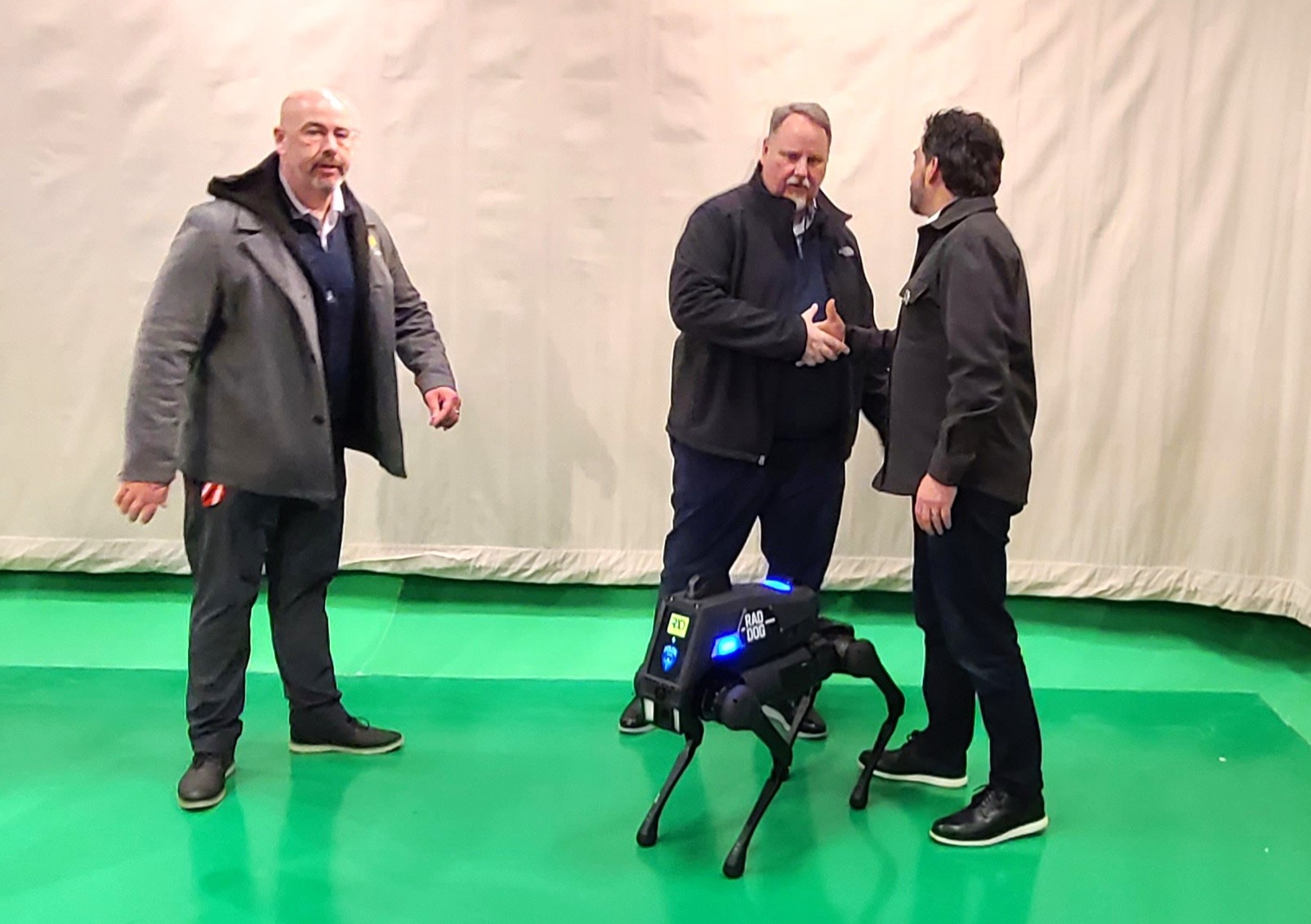
Robotic Assistance Devices’ Troy McCanna (left), senior vice president of revenue operations; Taylor Mayor Tim Woolley; and Robotic Assistance Devices’ Steven Reinharz, chief executive officer and chief product officer, get a closeup perspective of RADDOG, a law enforcement robotic dog, as it goes through its paces March 19 in the Taylor media center.
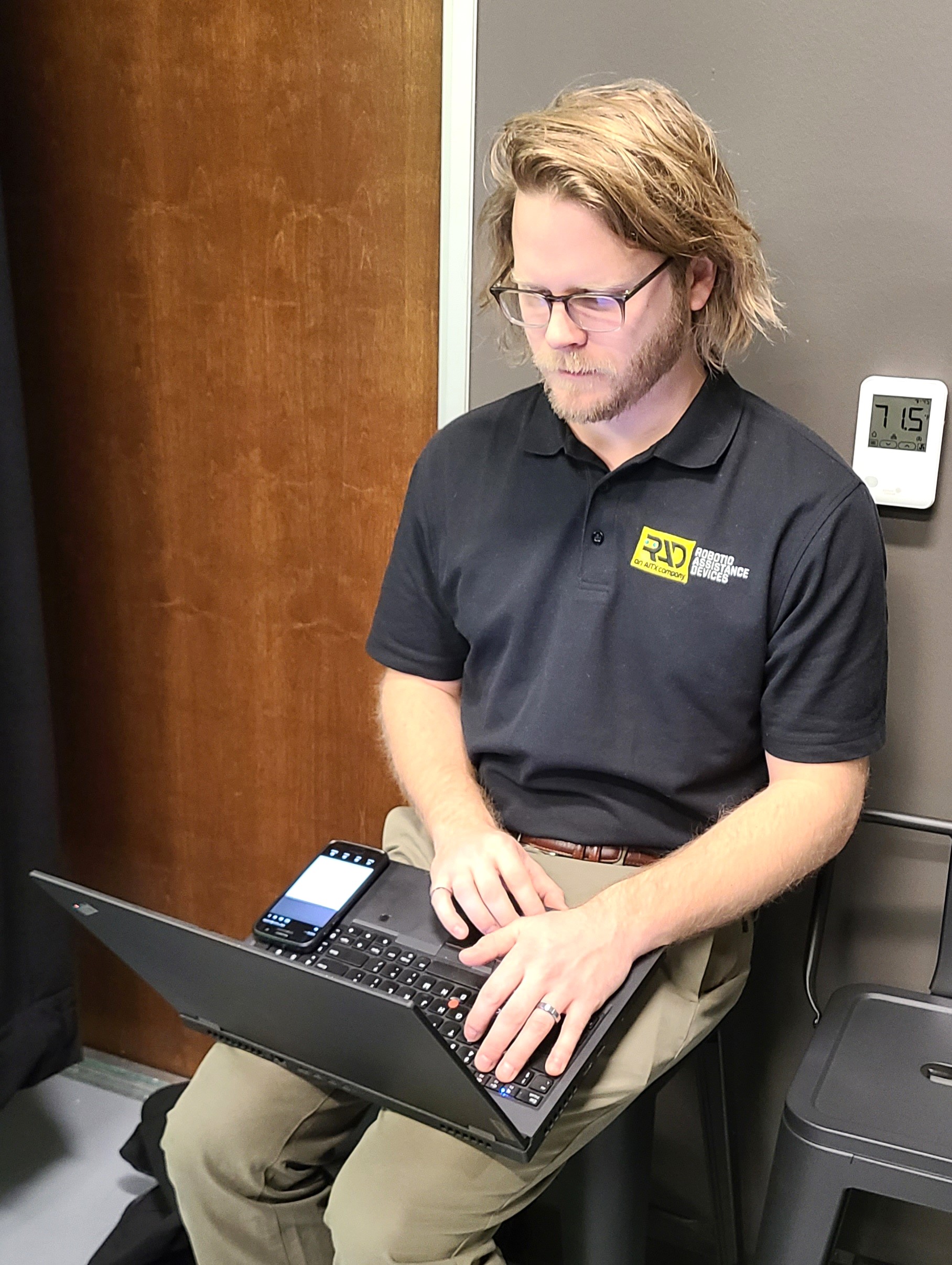
Dan Dreise, an electrical designer for Robotic Assistance Devices, a subsidiary of Artificial Intelligence Technology Solutions, operates the RADDOG from a distance March 19 in the Taylor media center.
By SUE SUCHYTA
Sunday Times Newspapers
TAYLOR – RADDOG, a robotic law enforcement dog that the Police Department is leasing to help them in hazardous situations, went through its paces March 19 at the city’s media center.
The robotic dog is a product of Robotic Assistance Devices, a subsidiary of Artificial Intelligence Technology Solutions of Ferndale.
RADDOG enters areas where its human law enforcement officers would be at risk, and communicates through audio and video feedback using a screen on its face, relaying live messages from a remote human user.
The Police Department is leasing the robotic dog for one year. With warranty, the total cost is $35,000 per year. Technical upgrades may become available at an additional cost. American Rescue Plan Act money was originally earmarked to cover the cost, and future expenditures have been incorporated into the police department’s budget from other sources.
Police Chief John Blair said the training needed to control the robotic dog is fairly straightforward.
“It’s incredibly simple, not unlike many people you see playing video games now, with a little joystick device,” he said. “That’s how we operate the dog.”
Blair said the range is unlimited, and you can control the dog as long as there is a cellular signal connection.
He said the Police Department could have used RADDOG four to five times in the last month alone.
“We had a couple of barricade situations, we had an individual who was inside of a house that actually shot at our officers, and it would have been a perfect time to employ the dog,” Blair said. “Unfortunately, it wasn’t delivered yet, so we had to do things the old-fashioned way and try to make phone contact with them.”
Blair said RADDOG would provide police officers with a different avenue to establish contact with a person.
Blair said if RADDOG is knocked over, it is able to right itself. If it is shot, it can be put out of commission just like any other machine.
He said RADDOG had no problem negotiating light snow on the ground, can climb and descend stairs, and can step over obstacles.
“If someone tries to pick it up, we can move those legs as a means of trying to escape away from it, but, again, it’s not unlike any other piece of machinery that you could pick up and tamper with,” Blair said.
Blair said the community and school children would be engaged to name the robotic dog.
Mayor Tim Woolley said using RADDOG is a great way to keep both police officers and residents safe.
“There’s a price on it, but at the end of the day, we have it in our budget and it’s what we want to do,” he said.
Woolley said the Police Department is starting with a one-year lease, and if it proves to be a valuable asset, they will continue to use it.
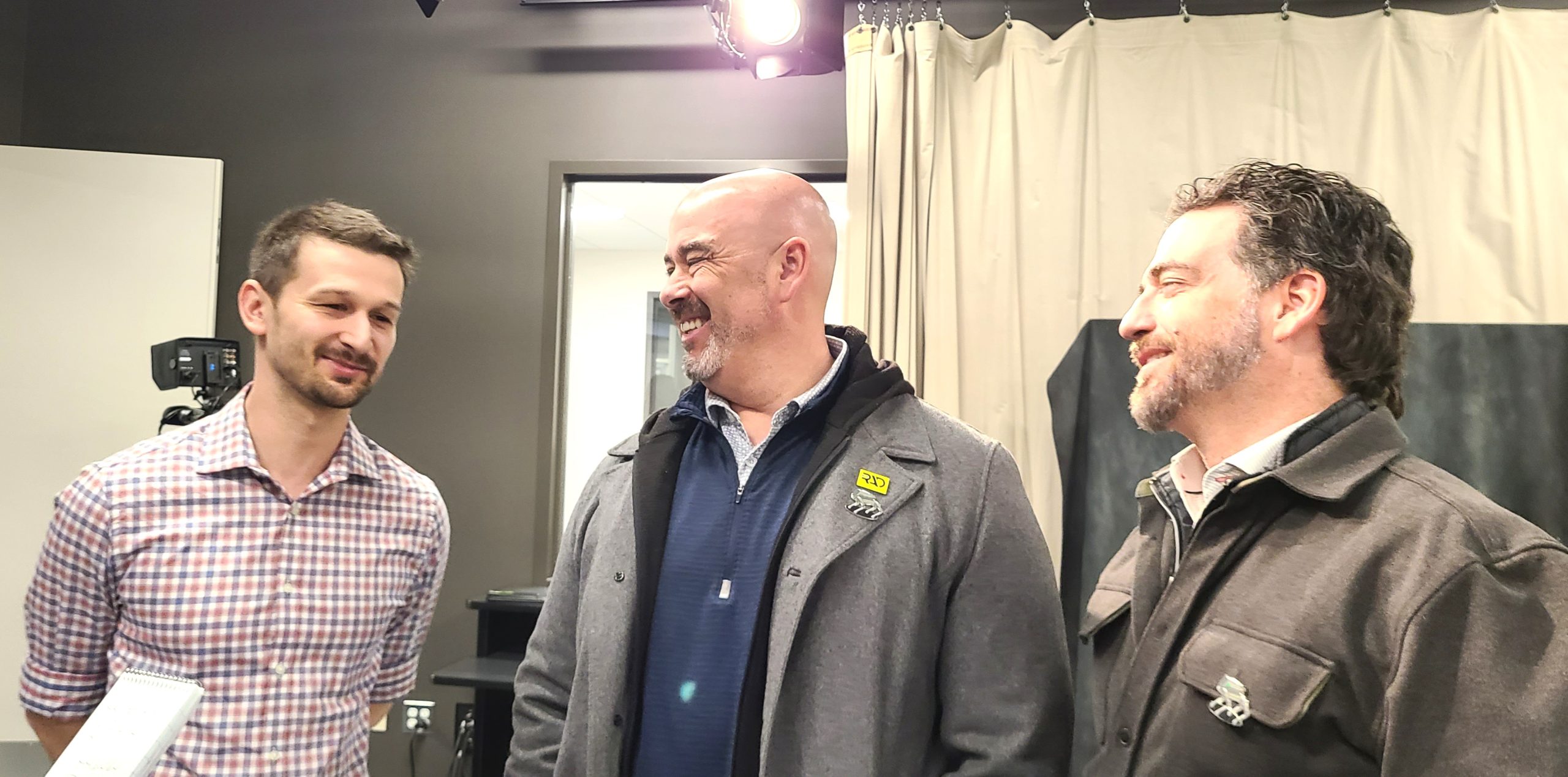
Robotic Assistance Devices’ Ioan Pop (left), vice president of engineering and research and development; Troy McCanna, senior vice president of revenue operations; and Steven Reinharz, chief executive officer and chief product officer, enjoy the RADDOG demonstration March 19 at the Taylor media center.
Blair said RADDOG would be deployed where they want to have two-way communication with a person.
“A barricaded gunman situation, or someone that was inside of their home and suicidal,” he said. “Instead of escalating the situation, we can put in this robot, which has a camera directly on the front of it that allows an officer’s face to actually be on there, so they can have two-way communication there, can speak to each other in a less confrontational manner.”
Blair said that in addition to being a de-escalation tool, RADDOG could be a public relations tool to show what the Police Department is doing for the community.
“We try to remove ourselves from dangerous situations and provide people an opportunity to calm down before they have to encounter an actual officer,” he said.
Ioan Pop, vice president of engineering and research and development for RAD, a subsidiary of AITX, said RADDOG weighs about 45 pounds, and is about one-half meter long and one-half meter tall.
“It can walk at a brisk pace,” he said. “It’s not meant to chase people down, but is able to follow and keep up.”
Pop said RADDOG can climb stairs, ramps and curbs, and it has a recovery sequence whereby it can get back on its feet in about 10 to 15 seconds if it is pushed or falls over. It does not currently have the ability to pick up objects.
Steven Reinharz, RAD AITX founder, chief executive officer and chief product officer, said they have developed about 20 RADDOG units to get to its current state of development.
“This is phase one, gen(eration) one, and the reason the partnership with Taylor is so important to us is that we are going to be collecting real, empirical information, use cases and experiences, that will immediately get to go to phase two, which we will deliver to Taylor P.D. as part of this contract, in about seven months, plus or minus,” he said. “And that will be a big step up.”
Reinharz said they are thrilled that the Police Department will be able to use RADDOG to improve police officer safety.