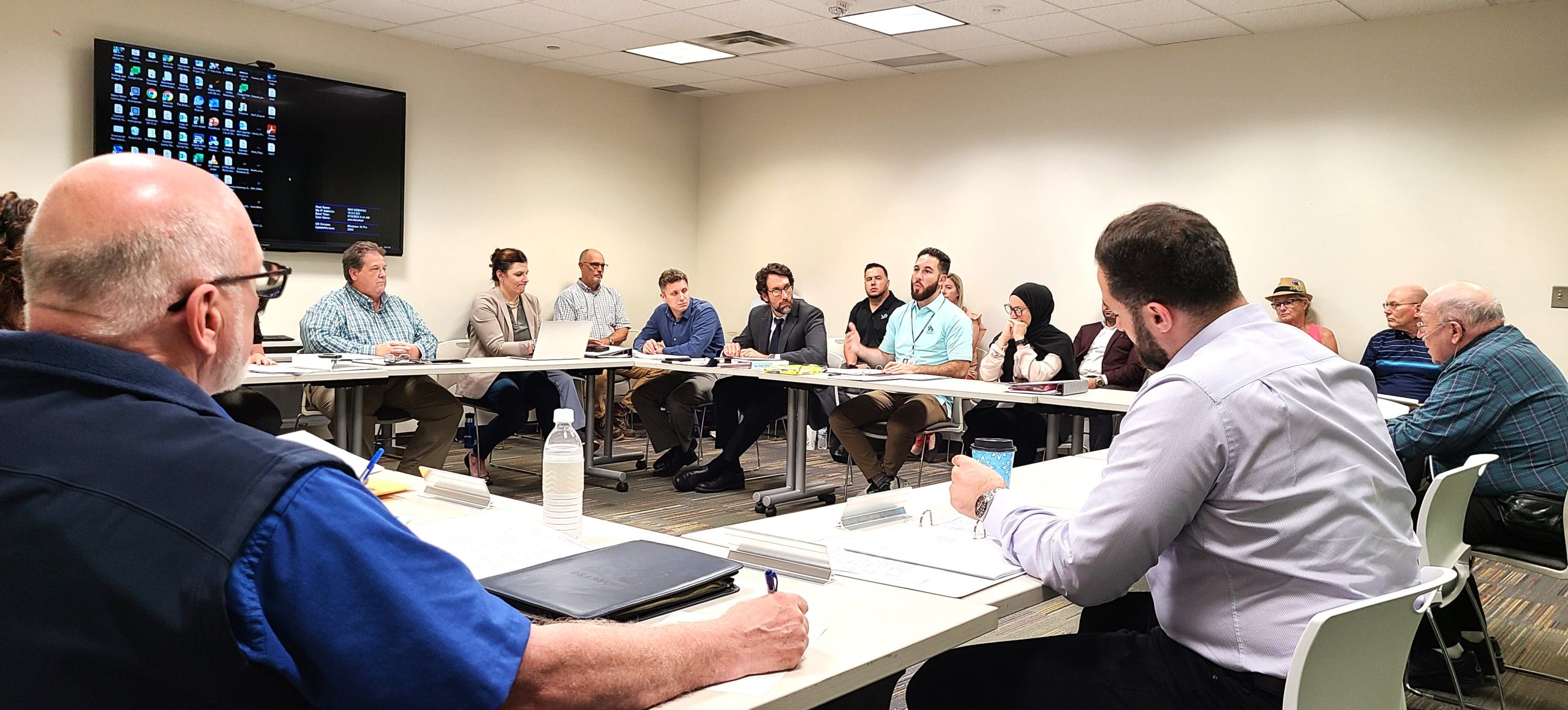
Dearborn Mayor Abdullah Hammoud (sixth from left) speaks during the Sept. 21 mayoral briefing to the City Council about the challenges of finding governmental funding for flood mitigation projects versus those that would prevent raw sewage from overflowing into the Rouge River during extreme rain events.
Hammoud briefs council on funding challenges
By SUE SUCHYTA
Times-Herald Newspapers
DEARBORN – Mayor Abdullah Hammoud spoke Sept. 21 on the challenges of getting governmental funding for flood mitigation projects versus those preventing sewage from entering the Rouge River during extreme rain events.
During a briefing to the City Council, the mayor explained that for the city to be in compliance with the Michigan Department of Environment, Great Lakes and Energy permitting standards for outfalls 13 and 14 in the southwest end of Dearborn, where the city has not yet separated rainwater runoff from sewage, the city might be compelled to construct a rapid discharge station, at a cost of $50 to $60 million.
“When you have heavy rainfall, it doesn’t do anything to prevent flooding, but when we go to empty out into the Rouge, it will inject a quick round of chlorine and eliminate some of the bulk solids, the raw sewage,” he said.
Hammoud said that during the city’s discussions with EGLE, the body said it want to mandate the city to improve the Rouge River water quality, while city officials want to first focus on flood mitigation.
“We think flood mitigation takes precedence over water quality,” he said. “I hate to put it in that framing, but if I am going to spend $60 million in the city, it should be to prevent raw sewage from going into people’s basements before I focus on raw sewage entering the Rouge River.”
Hammoud said that after months of discussion, the city and EGLE have agreed to several stipulations.
He said the U.S. Army Corps of Engineers is supposed to conduct a flood mitigation study across southeast Michigan, beginning in two to three years, which is not supposed to be municipally specific, but more regional in nature. The study itself will take another three to five years to complete once begun.
“EGLE has agreed to postpone our need to construct this rapid discharge (station) pending the outcome of what the U.S. Army Corps of Engineers study says,” Hammoud said. “So, they want to default to what the Army Corps of Engineers says is best for water quality and flood mitigation versus just making a $60 million investment on water quality and zero on flood mitigation.”
Hammoud said he is happier with that outcome.
“If we are going to go to the residents and ask them for an increase in the water bills or whatever it might be, we think the primary focus should be flood mitigation first and foremost,” he said. “Especially flood mitigation against the basements of our residents.”
Hammoud said that water quality in the Rouge is obviously important, but the sewage overflow only occurs during catastrophic rain events.
He said he didn’t feel that the cost and impact on the residents was worth it unless the project also protects their basements.
Hammoud said he learned through U.S. Rep. Rashida Tlaib (D-12th District) that it is EGLE, not the Environmental Protection Agency, that is asking for prevention of the raw sewage outflow into the Rouge River during extreme rain events.
Hammoud said the Michigan Legislature passed a $1.5 billion appropriation through the American Rescue Plan Act for water and sewer infrastructure work in the state of Michigan, but it placed its primary focus on water quality.
“So, EGLE told us, to incentivize you to construct this $60 million, we are willing to give you a $20 million forgivable loan,” he said. “So, we said we’d like to rework that $20 million towards an $80 million project called the open interceptor, which would help reduce flooding, and EGLE said we can’t shift the dollars toward that project because the focus has to be water quality and not flood mitigation.”
Hammoud said he believes that the stipulation that put river water quality over flood mitigation is shortsighted.
The mayor said the city has $90 million in lead water pipe connection replacements that have to be completed over the next 20 or so years.
Hammoud said the city’s pending water and sewer infrastructure study will be presented next spring, and city officials want to see the results of that study before they commit a large amount of money elsewhere.
“If we are going to allocate funding again, I would like to allocate it toward something that actually improves the public health of our residents immediately,” he said.
Hammoud said water rates would have to increase the cost of bonding any large project and to cover the cost of any loan that EGLE might provide.
The mayor said the agreement with EGLE would allow the city to do what the Army Corps of Engineers determines is the best solution.
Hammoud emphasized that the water quality issue is strictly with respect to preventing sewage from entering the Rouge, and has nothing to do with the quality of drinking water that enters into residents’ homes.
The mayor said the contract with EGLE will be in writing, and will not be renegotiable with future city administrations.
Hammoud said the Great Lakes Water Authority faces similar challenges with EGLE in reducing sewage outflows during rain events. GLWA has reached a 97 percent reduction in outflows of raw sewage, but EGLE wants GLWA to get to 100 percent, which will cost billions of dollars in investments.
“GLWA has been supportive of us and we have been supportive of GLWA to ask EGLE again to shift your priorities,” he said. “Flood mitigation first, with the indirect impact of improving water quality. The more sewer separation we do, obviously the more water quality improvement that happens.”