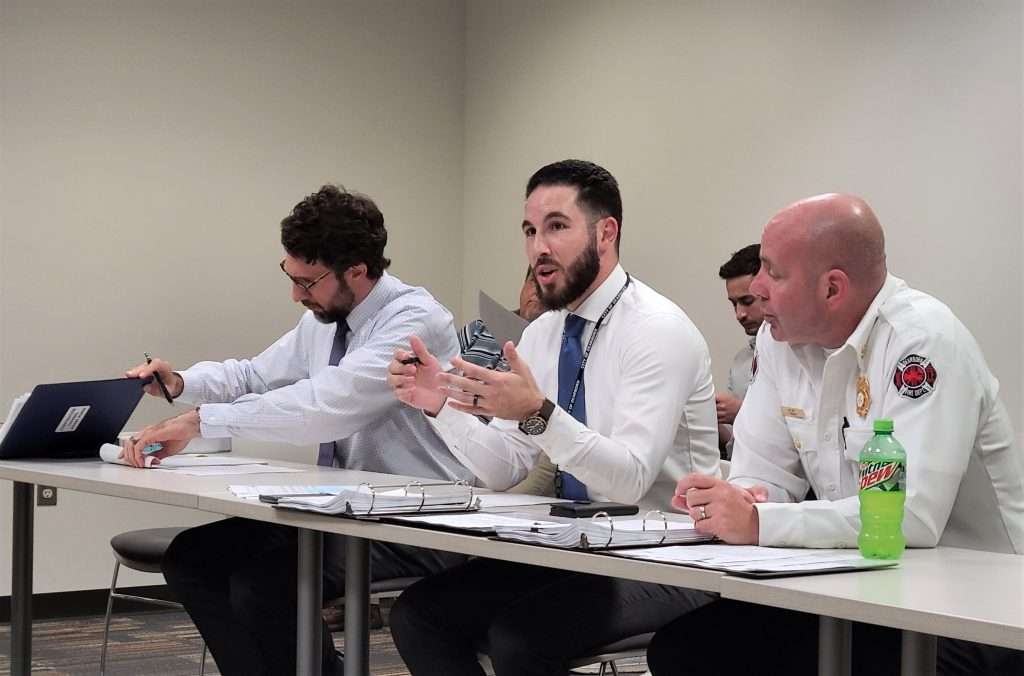
Dearborn Mayor Abdullah Hammoud (center) outlines rat abatement strategy Sept. 8 as Deputy Corporate Council Brad Mendelsohn (left) and Fire Chief Joseph Murray listen.
By SUE SUCHYTA
Times-Herald Newspapers
DEARBORN – Using sterilized feral cats and pheromones, power-washing restaurant trash bins, commercial-size rat traps and rodenticide are being considered to abate rats, Mayor Abdullah Hammoud said during a Sept. 8 meeting.
Hammoud said the feral cat program being considered would help combat the city’s rat woes.
“We have about 200 felines right now in the (Friends for Animals of Metro Detroit) trailers that we’ll vaccinate, neuter, spay and tag on their ear and you can actually let them out in key neighborhoods to assist you,” he said. “The tag lets you know that they were vaccinated.”
Hammoud said Chicago and New York have used feral cat programs to address rat problems.
 “It’s not that the cats are killing the rats,” he said. “The pheromones of the cats push away the rats, so it’s not like you are going to see a bunch of dead rats just merging with blood on the streets, just to be clear.”
Hammoud said the rat abatement program is multi-faceted.
“We are finalizing the special assessment creation for all of the public lots, for all of the businesses that use the city’s Dumpsters,” he said. “We are going to assess them for the fees for the Dumpsters and the cleaning of the Dumpsters. We are no longer going to assume that responsibility.”
Hammoud said he doesn’t know why the city assumed the responsibility for power-washing restaurant trash bins in the first place, and said twice a month power washing would be implemented for the trash bins, with the businesses being charged for the service.
He said a formula would be established based on the type of business and square footage and when city officials think they have a working proposal, they will review it with the city council.
Hammoud said the Downtown Development Authority has allocated $10,000 for commercial-sized rat traps which would be located near trash bins.
“The problem is, you might hear a rat squealing,” he said. “But what is worse, hearing it squealing, or seeing it under your (outdoor) table while you are eating?”
Hammoud said city officials are considering secondary rodenticides placed directly into rat burrows, which are not accessible to larger animals, and they are looking at a rodenticide that won’t be hazardous to dogs and other similar animals.
“The only alternative to killing a rat is a rat trap, which you can’t display everywhere,” he said.
Hammoud said seeded dry ice, which is put in rodent burrows, has no legal vendor in the state of Michigan, and the city is not legally authorized to use it.
He said that while some people do not want rodenticide used, rat traps can be dangerous to children and other animals, while rodenticide can be placed deep in a burrow.
Hammoud said city officials are looking at multiple solutions while trying to determine the best way to use them in tandem.
“We know it is a growing issue for our restaurants in the city,” he said.
Hammoud said if a feral cat program is instituted, an educational component, including a town hall meeting, will be required.
“If we focus on addressing the rat issue, we are not focusing on the actual problem,” he said. “It’s a garbage issue, which serves as a food source for rats. So, if we address the garbage issue in our heavy commercial restaurant districts, we can begin to take away from the rats that are emerging.”
Hammoud said the city will never be able to address the rats in the sewers, and when sewer lines are dug up and replaced, rats will emerge.
He said the power-washing of trash bins in the concentrated restaurant areas will be tried first, and after the results are evaluated, it will be determined if and how to expand power-washing.
Hammoud said he can’t enforce the power-washing of private commercial trash bins unless it is done by ordinance.
“In my mind, it was like, how do I get others to adopt this,” he said. “I can enforce it, which is always being heavy-handed, or I am a big believer that if you do a façade improvement and you make something respectable and nice, people begin to treat it that way.”
Hammoud said an information campaign should be warranted first and foremost, before city officials demand businesses take specific steps.
He said if multiple businesses share the cost of power-washing a trash bin, it is less burdensome than requiring a business to power-wash a bin for which they are the only user.
“For me, though, it’s not fair that in other business districts, the city assumes the cost of the Dumpster,” he said. “That’s a special privilege in my eyes and it doesn’t happen anywhere else in the city, and I think it has become a disaster. When you see pictures on social media where the garbage is piled up, that’s on us.”
City Council President Michael Sareini said the city should make sure its own assets are clean before it starts telling private businesses to power-wash their areas.
He also said that instead of providing more trash bins, the existing bins should be emptied more frequently.
Hammoud said his biggest concern is the trash bins near restaurants being a food source for rats.
“The rat problem is getting bigger and bigger,” he said. “We can be the restaurant city of America, but nobody will want to come to your restaurants if rats are frolicking.”
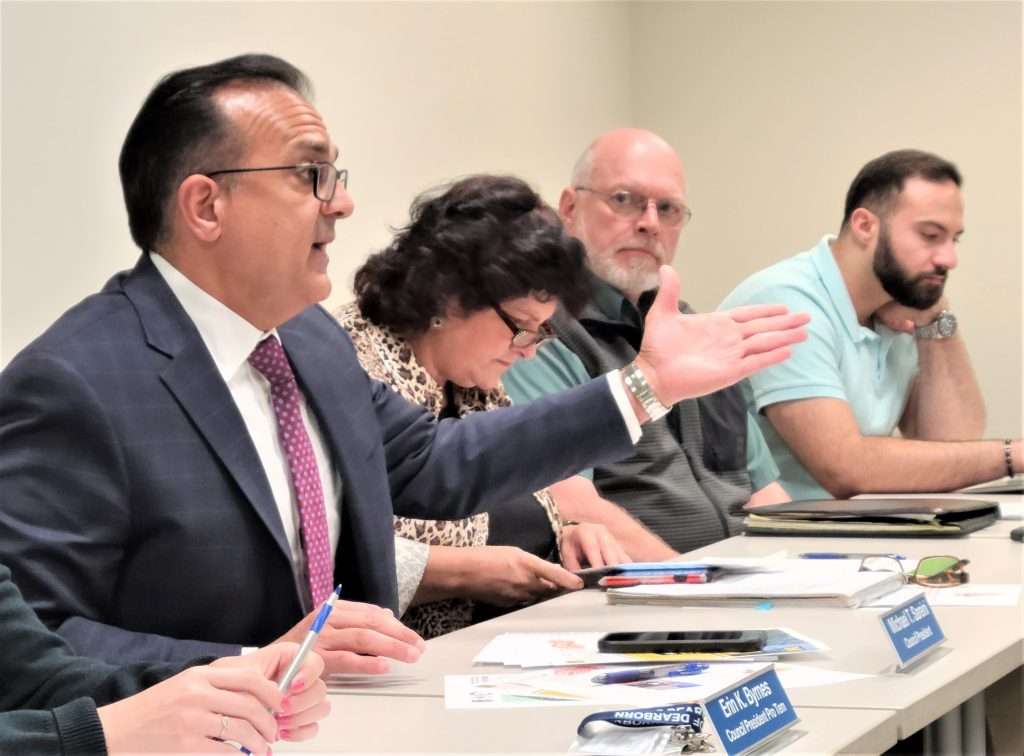
City Council President Michael Sareini (left) addresses the special assessment proposed for business trash bin power-washing Sept. 8, part of the proposed rat abatement strategy, as City Councilmembers Leslie Herrick, Ken Paris and Mustapha Hammoud listen.