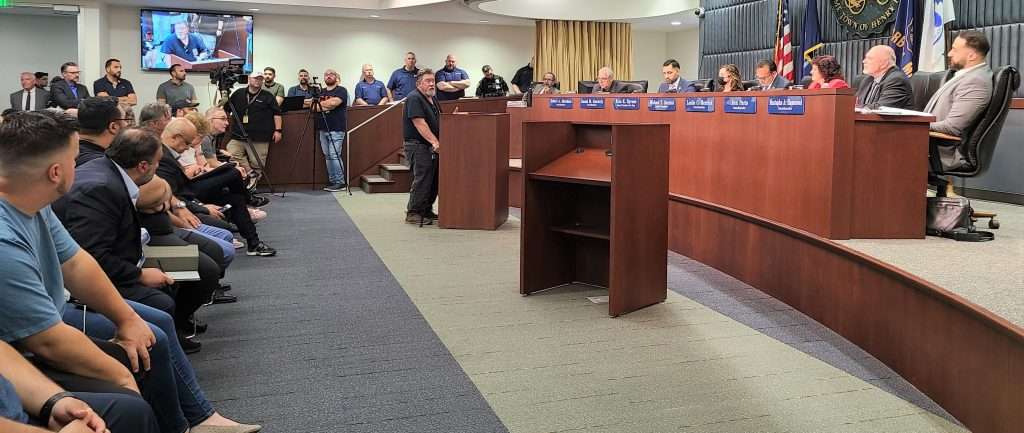
A packed house greeted the Dearborn City Council during its June 7 special meeting, as city retirees worried about changes to retiree health care, which will see an increase in deductibles.
By SUE SUCHYTA
Times-Herald Newspapers
DEARBORN – Residents and city retirees packed the city council chamber and overflow rooms June 7, during a special council meeting at which the council, 6-1, approved the budget.
Councilmember Ken Paris cast the lone dissenting vote.
Mayor Abdullah Hammoud’s first budget was challenging to achieve, since voters did not renew the city’s supplemental operating millage last November, and his administration acted to reduce the city’s structural deficit of $22 million by $20 million, with the goal of totally eliminating the structural deficit by Hammoud’s second year in office.
A structural deficit occurs when the city spends more than it takes in. In recent years, the city has used its savings or utilized one-time funds to cover its spending.
The city’s $128 million budget, which takes effect July 1, focuses on flood mitigation, traffic infrastructure, park improvements and vector control to address the city’s rat problem. It also proposes changes to the design of retiree healthcare benefits.
A comprehensive study of the city’s water and sewer infrastructure is meant to address future flood mitigation, and will provide a plan which will enable the city to better manage storm runoff from heavy rains, as well as to provide more green spaces in the city to absorb rainfall.

Mayor Abdullah Hammoud (left) speaks about the city’s 2022-23 budget, while City Attorney Jeremy Romer listens.
The budget for the city’s traffic infrastructure needs will address residents’ concerns about speeding and reckless driving, by adding speed humps, radar speed measuring signs and the redesign and re-engineering of streets to make roads safer for drivers, bicyclists and pedestrians.
Free pool entry for children 13 and younger tops the list of Parks and Recreation changes, along with plans for three new soccer fields, splash pads, basketball and tennis courts, and long-deferred park improvements.
The city’s rat issues will be approached with an expanded vector control program. Vector control attempts to limit the transmission of pathogens by reducing or eliminating human contact with the vector, which is a living organism, like mosquitoes or rodents, that transmit infectious diseases.
The city’s proposed changes to the structure of retiree healthcare, which the city stopped offering in 2012, drew concern and spiked attendance at the meeting.
The new budget would institute a $250 deductible for post-Medicare retirees, and a $500 deductible for pre-Medicare retirees 65 and younger. Other retiree plans will not be impacted.
In the past, retiree deductibles ranged from zero to $250.
The city will pre-fund the deductibles for the first two years of the implementation through the establishment of Health Care Reimbursement Arrangements, and a hardship provision for those who cannot afford the deductibles, based on income changes, will be provided.
The city’s retiree health care benefit, which is part of other post-employment benefits, have been under-funded since 2007, and have not set aside $60 million in actuarily-recommended contributions.
Hammoud said he has amended his and his senior staff’s health plans to include a $2,000 deductible plan for individuals.
He said the budget process was approached with both meticulous detail and with compassion and care.
“In the end, we offered a path forward that resulted in no layoffs, no service cuts, and the long-term preservation of retiree benefits,” Hammoud said.
He said the budget process included providing detailed documentation for city council members, seven weeks worth of budget presentations, town halls at each of the city’s public high schools, which were in-person and live streamed on Facebook, a public town hall meeting with retirees, and many other meetings and phone calls with budget stakeholders.
Hammoud said the budget creation was a team effort.
“I’m grateful for the support, input and vigorous debate offered by our city council to move this budget and our city forward,” he said.
Paris said he believes the city’s health care changes were implemented too quickly, and it “put the cart before the horse.”
“We didn’t go ahead and inform properly our retirees and our active employees what was going on in the city,” he said. “I think we had the inability to adequately roll out information about the health care proposal, even though it developed into an urgent need for clarity, transparency and inclusion in the process.”
Paris said a lot of inaccurate information was circulating.
“I had all sorts of calls, thinking that health care was going to be taken away, the OPEB funding was down to 10 to 15 percent funded, which is far from it,” he said. “I got a lot of emails and phone calls about the library, for which a lot of erroneous information was going out. This administration and this council were very hard on this budget, but, still, there was a lot of misinformation that went out.”
To clear up any questions residents might have about the upcoming city budget, documents and information for the fiscal year 2023 budget are on the city’s website, cityofdearborn.org.