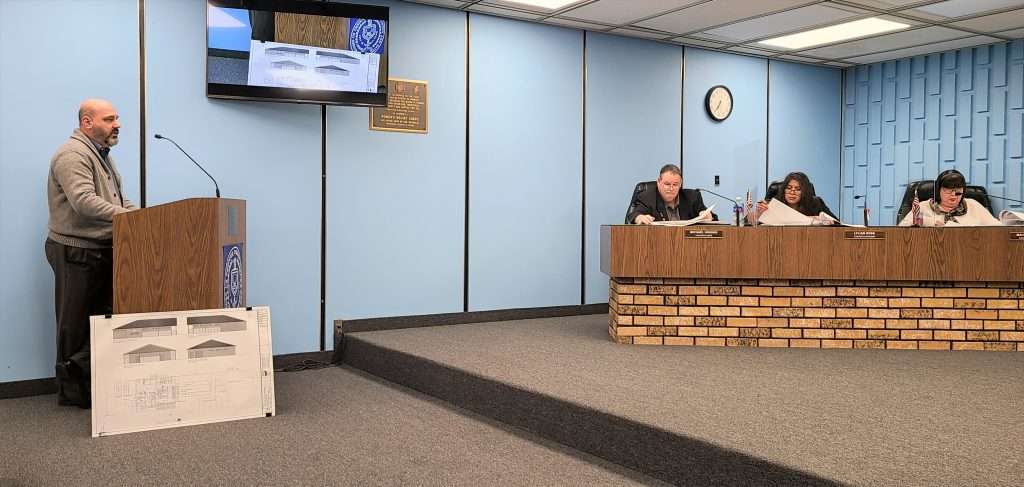
Hennessey Engineers Project Architect Raymond Parker (left) speaks about the proposed Lincoln Park animal shelter during an April 18 study session prior to the city council meeting, as City Councilmembers Michael Higgins, Lylian Ross and Maureen Tobin looks at facility plans.
Facility would house more dogs, but lacks space for cats
By SUE SUCHYTA
Sunday Times Newspapers
LINCOLN PARK – A proposed new, larger animal shelter, with more room for dogs but no provision for cats, was discussed during an April 18 study session prior to the City Council meeting.
The presentation, led by Hennessey Engineers Project Architect Raymond Parker and Police Chief Raymond Watters, who oversees animal control, described the features of the proposed 3,100-square-foot building, with 24 kennels, as well as adoption rooms, a lobby, evaluation and storage areas, and an enclosed yard.
The initial estimate is $774,182, including work on the site and the building.
The new building would be northwest of the existing pre-fab kennel building, north of Russell Avenue and east of Le Jeune Avenue.
Three of the kennels would be set aside for isolation and evaluation, so a dog can be evaluated for 24 hours when it first arrives at the shelter, with separate exhaust fans as well, to help curtail the spread of disease.
The kennel floor area would be a two-part epoxy on top of concrete block, and the kennel separation walls are poured-in concrete block, sprayed with epoxy, which seals it, since untreated concrete is porous and allows space for bacteria and viruses to thrive.
Epoxy used in kennels can have anti-microbial additives that inhibit bacterial and viral growth, and are easy to clean.
Parker said they designed the east side of the building with a gabled roof, so if an addition is needed in the future, it could be added on from that point.
“With the rising cost of construction materials, labor shortages and everything else, the final total picture we are looking at is close to $700,000, and I think it was $580,000 originally two years ago when we looked at it,” he said. “Material cost – lumber – has just gone through the roof.”
Parker said the shelter workers and the animal control workers had input into the features they wanted to include, including the garage and the kennel spaces.
He said the proposed design is set up only for dogs, and a separate room would be needed to accommodate cats.
“Based on the number of kennels that were needed on a weekly basis, it was cut down to this version,” he said. “This is 3,100 square feet. The other one was almost 5,000 square feet.”
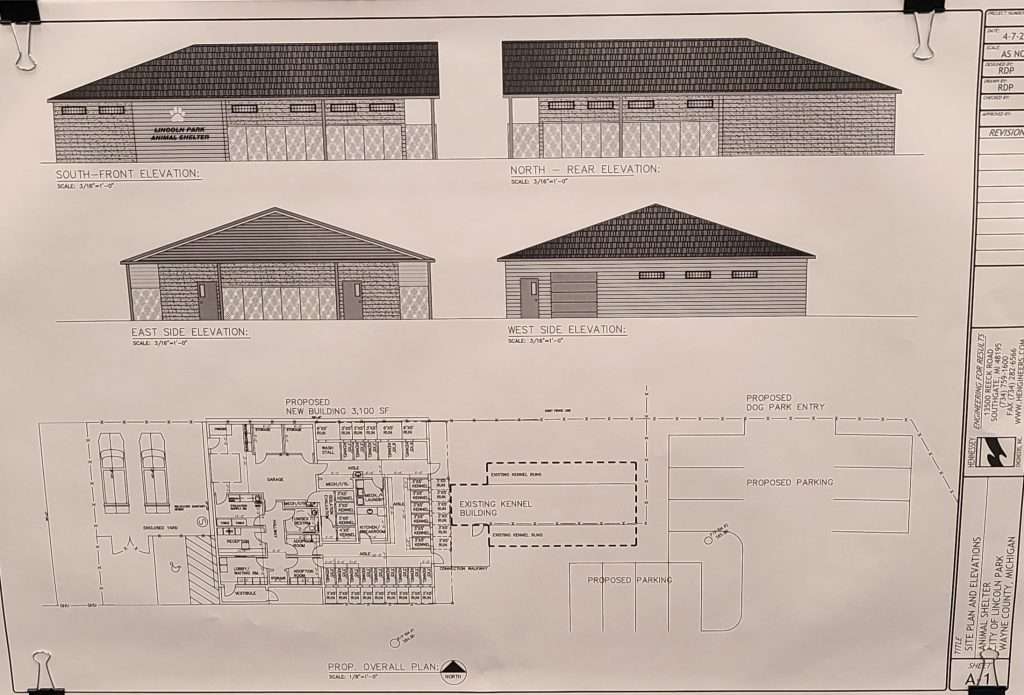
A site plan and elevation views for the proposed Lincoln Park animal shelter displays information during an April 18 study session prior to the city council meeting.
Mayor Thomas Karnes said if the city is going to build a shelter, they should do it in a way that accommodates all animals, including cats.
“It makes sense to me, if we are spending three-quarters of a million dollars and we have the one opportunity to do it, we should do it the way we are taking care of all the animals that come in,” he said.
Parker said the challenge is that cats have to be isolated from the dogs.
“You are creating almost a separate space for them,” he said. “We could create a space, if needed, to expand this and include that.”
Parker said cooling in the building would be accomplished through a forced air or a heat pump system.
He said there is a high-powered fan that moves the air out of the shelter and exchanges the air a fixed number of times each hour, which is needed with that many animals, and moving the air in that manner provides a cooling effect, and only the office areas would have air conditioning.
Watters said the fees the shelter charges are not meant to sustain it, but by having its own shelter the city doesn’t have to pay another city’s shelter to take in its strays.
He said the original plan was to try to use the current shelter, which is a trailer, for the cats, but he said the pre-fab building is starting to fall apart.
“If we started to use it, and it got to the point where we couldn’t use it, I don’t know what we are going to do with a whole house full of cats,” Watters said. “This is phase one, and phase two was going to be the cat house.”
He said that two years ago, phase one of the animal shelter would cost $500,000, and phase two, for the cats, would be tackled later.
“Unfortunately, costs have gone crazy, but this really does give us what we need for phase one,” Watters said.
Councilmember Maureen Tobin expressed concern that the city was still not equipped to take care of stray cats.
Watters said the current shelter building has been at capacity with dogs a few times.
“They have been doing a lot better, as they come in, at finding the owners, or finding them spots at other refuges or adopting them out quicker,” he said. “COVID really helped that situation out. People were at home, people wanted pets, so that really helped us a lot.
“We were pretty close to full when the pandemic hit, and we have been staying under, and they are doing pretty well right now.”
Watters said he doesn’t want to get to the point where they can’t take in any new animals, especially if it is a situation with a dog bite or a vicious animal.
He said the quarantine room in the proposed facility is crucial to preventing the spread of disease when a new intake is ill.
Watters said the city was in a bind when it obtained the prefab animal shelter, because it was unable to obtain animal shelter services from nearby cities.
“We had nowhere to go,” he said. “Taylor dropped us, and we really were in a corner, and we did the best we could at the time, and this really was supposed to be a temporary shelter, and it has done its job.”